How to Safely Purchase Established and Vintage Facebook Accounts with Verified Histories
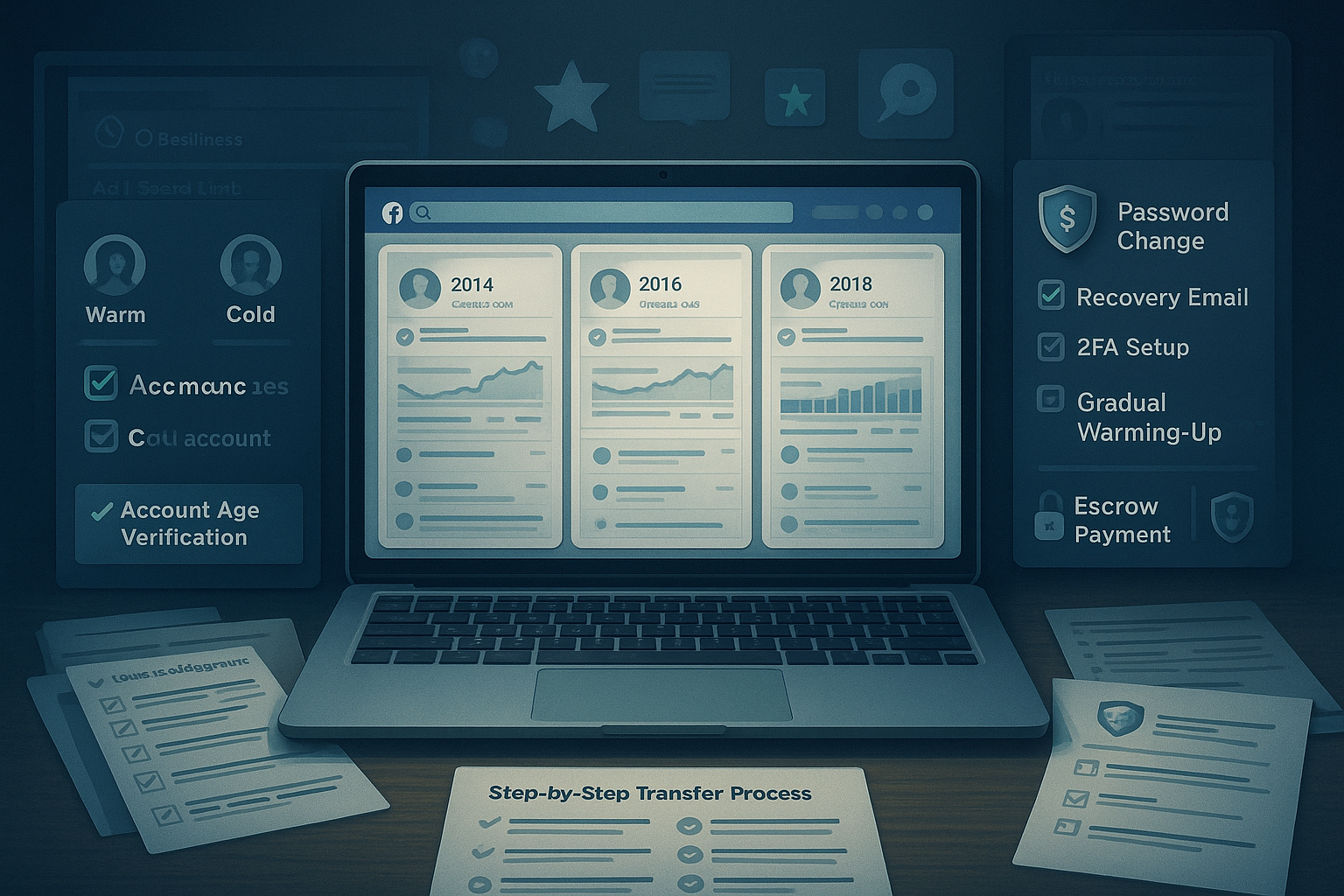
A Facebook account created today and one created seven years ago are not the same product, even if their profile pages look identical. The difference lives in the platform's internal trust architecture - a layered system that weighs account age, behavioral consistency, and historical activity when deciding how much freedom any given profile receives. New accounts face compressed ad spend limits, aggressive verification triggers, and a probationary period that can stretch for months before the platform treats them as ordinary users. Established accounts have already passed through that gauntlet.
This reality has created a genuine market for aged profiles. Advertisers who need to run campaigns at scale, agencies managing multiple client assets, and entrepreneurs building social presence from a position of credibility have all discovered that purchasing an account with documented history can eliminate weeks or months of platform conditioning. The demand is real, the supply is structured, and reputable marketplaces now exist specifically to match buyers with verified inventory. Many experienced operators now routinely buy facebook old accounts through specialist platforms where creation dates, activity records, and account condition are confirmed before any transaction occurs.
What this guide covers is the complete process: what makes established accounts genuinely valuable, how to evaluate what you are buying, how to verify the seller, how to complete the transaction without financial risk, and how to manage an acquired account without triggering Facebook's security systems. Every section is practical, specific, and grounded in how this market actually functions.
Why Established and Vintage Facebook Accounts Have Real Market Value
The value of an aged Facebook profile is not sentimental - it is structural. Facebook's internal systems assign different operational parameters to accounts depending on how long they have existed and how consistently they have been used. This affects everything from daily ad spend ceilings to the ease of connecting a profile to a Business Manager without triggering a review.
A profile that has logged regular activity over several years has, in effect, demonstrated to the platform that it behaves like a normal human user. It has accumulated friends gradually, posted at irregular intervals, engaged with varied content, and survived multiple algorithm updates and policy enforcement cycles. Each of those signals contributes to a trust score that governs how the platform responds to its actions.
For advertisers, this translates directly to operational efficiency. Accounts with verified histories can often access higher spending thresholds from the first campaign rather than waiting through a gradual limit expansion process. For page administrators, an aged profile connected to a business page creates a credibility layer that new profiles simply cannot replicate. For agencies running operations across multiple client accounts, having reliable profiles with established histories reduces the constant attrition that comes from working with fresh accounts that trigger restrictions without warning.
- Higher advertising spend limits compared to newly created accounts
- Reduced frequency of automated security checks and verification prompts
- Greater eligibility for Business Manager and ad account connections
- Existing friend networks and engagement histories that signal organic use
- Demonstrated login and posting patterns that satisfy platform behavioral checks
- Stronger baseline credibility for page administration and group management
Account value also scales non-linearly with age. A five-year-old account is not simply two and a half times more valuable than a two-year-old account. It occupies a qualitatively different trust tier. The scarcest profiles - those created a decade or more ago with consistent activity throughout - are genuinely rare and command premium prices for that reason. Understanding this tiered value structure is the first step toward making a purchase decision that matches your actual operational needs.
Understanding the Different Types of Aged Facebook Profiles Available
The market for established accounts is not a single homogeneous inventory. Profiles differ significantly by age, activity level, and the assets connected to them. Buyers who approach this market without a clear framework for classification often either overpay for features they don't need or acquire accounts that don't fit their intended use case. Understanding these distinctions before you attempt to acquire vintage Facebook accounts saves both money and operational headaches.
Account Age Tiers and What They Mean in Practice
Age is the primary axis along which established accounts are classified, and it determines the baseline level of platform trust a profile carries. The market has developed informal but consistent tiers that reflect real differences in operational capability.
| Age Tier | Approximate Account Age | Typical Use Case | Platform Trust Level |
|---|---|---|---|
| Entry-level aged | 1-2 years | Basic advertising, group management | Moderate |
| Mid-tier vintage | 3-5 years | Business Manager, page administration | High |
| Premium vintage | 6-10 years | High-spend advertising, agency use | Very high |
| Rare legacy | 10+ years | Maximum trust operations, resale | Exceptional |
The practical implications of these tiers go beyond advertising limits. A mid-tier profile is generally sufficient for most agency and small business applications. Premium vintage accounts are the right choice when the operational goal involves sustained high-spend campaigns or when the profile needs to administer high-value assets without triggering review cycles. Legacy accounts are comparatively rare and are typically sought by buyers who need the highest possible trust baseline or who plan to hold the account as an operational asset over a long period.
Activity Profiles: Warm vs. Cold Accounts
Age alone does not fully describe an account's operational value. The activity pattern recorded within that account - its "warmth" - determines how ready it is for immediate use. A warm account has been used consistently: regular logins, posts at natural intervals, interactions with other users, and a behavioral pattern that the platform's systems recognize as normal human activity. A cold account may carry an old creation date but show years of dormancy, which undermines much of the trust advantage that age alone is supposed to provide.
Warm accounts are priced higher for good reason. They can typically be put to work more quickly after acquisition because they don't require an extended re-warming period before the platform treats them as active, trusted profiles. Cold accounts are not without value - their age still matters - but buyers should factor in the time and effort required to reintroduce activity before using them for advertising or other sensitive operations.
When evaluating any listing, ask directly whether the account has been actively maintained, how frequently it was accessed in the past twelve months, and whether the activity patterns visible on the profile reflect genuine human use rather than automated or bulk behavior.
Accounts with and without Connected Assets
Some profiles come bundled with connected assets: Facebook Pages, Groups, Business Manager accounts, or ad accounts with existing spend history. These bundled offerings add measurable value but also introduce additional complexity and risk that must be evaluated separately from the profile itself.
An ad account with an established spend history and a clean policy record is a significant asset. It may qualify for higher initial limits and faces less scrutiny when new campaigns are launched. A Business Manager with connected pages and verified domains represents even more operational infrastructure. However, any connected asset carries its own history, including any warnings, restrictions, or policy violations that may not be immediately visible. Buyers should treat connected assets as separate line items in their due diligence process - verifying each independently rather than assuming that a clean profile automatically means clean connected assets.
How to Verify a Seller Before You Buy Facebook Accounts with History
Seller verification is the most consequential step in the entire purchase process. The market for established Facebook profiles contains legitimate, professional suppliers operating transparent platforms alongside less scrupulous actors who exploit buyer unfamiliarity. The difference between a successful acquisition and a financial loss often comes down to how rigorously the buyer evaluated the seller before committing funds.
Evaluating Marketplace Reputation and Track Record
Reputable sellers operate through established platforms with verifiable histories. The platform itself should have been in operation for multiple years, display real and traceable buyer feedback, and clearly articulate its dispute resolution procedures. A supplier who cannot point to documented buyer reviews from independent sources, who operates anonymously without identifiable contact information, or whose platform was created recently with no track record warrants immediate skepticism.
Look for platforms that present specific, verifiable account details in their listings rather than vague descriptions. A legitimate listing for an account to purchase aged Facebook profiles will state the creation year, describe the activity level, identify connected assets, and disclose any known history. Listings that describe accounts in purely generic terms - "old account, good quality" - offer no basis for informed evaluation and should be avoided.
- Confirm the platform's operational history and founding date
- Read buyer feedback across sources independent of the seller's own platform
- Verify that dispute resolution policies are written and accessible before purchase
- Confirm that full account details are provided before payment is requested
- Check that the marketplace has identifiable contact information and a response history
What Documentation a Legitimate Seller Should Provide
When you set out to obtain established Facebook accounts from a professional supplier, the documentation provided before any payment should meet a clear minimum standard. Shortfalls in this documentation are not minor inconveniences - they are signals that the seller either cannot or will not support a transparent transaction.
- Account creation date with supporting evidence such as timeline screenshots or activity history
- Original registration email access or a confirmed replacement email arrangement
- Activity summary describing login frequency and content history
- Written confirmation that no active restrictions or policy violations exist on the account
- Details of any connected pages, groups, or advertising accounts included in the transaction
- Two-factor authentication status and the recovery options that will be transferred with the account
Red Flags That Signal a Fraudulent or Risky Seller
Certain patterns appear consistently in problematic transactions. Recognizing them before payment eliminates the most common categories of loss. Price is one of the most reliable early indicators - accounts priced dramatically below comparable market listings without a clear explanation almost always carry hidden problems, whether a restricted history, fabricated age documentation, or an account that will be reclaimed by the original owner shortly after transfer.
- No verifiable review history or entirely anonymous operation
- Prices far below market rates with no stated reason
- Refusal or inability to provide creation date documentation before payment
- Pressure to use payment methods that offer no buyer protection or recourse
- Account descriptions that are generic and contain no verifiable specific details
- No stated refund or replacement policy, or policies that are vague and unenforceable
How to Assess the Quality and Authenticity of an Account Before Purchase
Even when dealing with a reputable seller, each specific account requires independent assessment. Seller reputation establishes a baseline of trustworthiness, but it does not guarantee that any particular listing matches its description. Buyers who skip individual account due diligence are essentially trusting that no errors, misrepresentations, or omissions exist - a position that experienced buyers do not take.
Verifying Account Age and Creation History
The stated creation date of a profile can be cross-referenced through several observable data points. The account's earliest timeline posts, the dates of the oldest friend connections, early photo uploads, and the profile's "Intro" section update history all contribute to a picture of when the account genuinely originated. Sellers should provide screenshot documentation of these elements before purchase. Where possible, request visual evidence of the earliest available activity rather than accepting a stated date without supporting materials.
Be alert to profiles whose earliest documented activity appears suspiciously concentrated in a brief period. Genuine organic accounts accumulate their history gradually and unevenly over time. A profile that shows a burst of early activity followed by years of near-dormancy is worth examining carefully, as this pattern can sometimes indicate an account that was artificially seeded to establish an apparent creation date.
Evaluating the Activity and Engagement Record
Authentic activity history has recognizable characteristics. Post frequencies vary naturally. Friend additions happen in small numbers over extended periods. Engagement - comments, reactions, shares - comes from a geographically and demographically coherent network rather than from accounts concentrated in unrelated regions. The content itself reflects a consistent personal voice or interest pattern rather than generic filler.
Profiles whose activity patterns show characteristics of automated management - uniform posting intervals, bulk friend additions from unrelated regions, identical comment patterns across many posts - should be declined regardless of their stated age. These patterns suggest the account was managed by software rather than a human, which significantly undermines the trust value that aged accounts are supposed to provide.
Checking for Account Restrictions and Policy History
A profile's restriction history travels with it permanently. An account that has received advertising policy warnings, had its ad account suspended, or been flagged for community standards violations carries those records into any new owner's hands. Buyers should explicitly request written confirmation from the seller that no active or historical restrictions exist, and where possible, request that the seller demonstrate the account's current ad account status and Business Manager eligibility before the transaction is finalized.
| Quality Factor | What to Check | Why It Matters |
|---|---|---|
| Account age | Creation date with supporting evidence | Determines the platform trust tier |
| Activity warmth | Posting frequency, variety, and recency | Affects how quickly the account can be used |
| Friend network quality | Geographic and demographic consistency | Distinguishes organic from artificial growth |
| Restriction history | Ad account status and policy record | Determines advertising eligibility from day one |
| Connected assets | Pages, groups, Business Manager details | Affects total value and adds transfer complexity |
| Recovery access | Email, phone number, two-factor authentication | Essential for securing the account post-purchase |
How to Complete the Transaction Safely When You Acquire Vintage Facebook Accounts
Account quality and seller reputation mean little if the transaction itself is structured poorly. Buyers lose money and access not only to fraud but to legitimate deals that go wrong because the transfer mechanics were not clearly agreed upon in advance. A structured approach to payment and transfer protects both parties and gives buyers a clear recourse path if something does not go as agreed.
Choosing Payment Methods with Buyer Protection
Payment method selection is a risk management decision, not merely a convenience choice. The core principle is simple: use payment channels that allow you to dispute a transaction or reclaim funds if the seller fails to deliver what was agreed. Irreversible payment methods - direct cryptocurrency transfers to an unknown wallet, direct wire transfers to an unverified party - offer no recourse if the account delivered does not match the listing or if the seller disappears after payment.
- Use escrow services for high-value transactions, with funds released only after verified account access
- Prefer platforms with written buyer protection policies that cover non-delivery and misrepresentation
- Avoid irreversible payment methods when transacting with any seller for the first time
- Document all payment communications, transaction confirmations, and agreed terms before funds are sent
The Account Transfer Process: What Should Happen Step by Step
A legitimate transfer follows a defined sequence. When sellers resist this sequence - insisting on full payment before providing any verifiable account details, for instance - that resistance itself is informative. Professional suppliers accept structured transfers because they have nothing to hide and because clear processes protect their reputation as much as they protect the buyer.
- Seller provides complete account documentation for buyer review before any payment is initiated
- Buyer independently verifies that credentials are active and that the account matches the described specifications
- Payment is placed in escrow or made through a protected channel with documented terms
- Seller provides complete login credentials, including original email access where included in the agreement
- Buyer confirms full account access and verifies that all details match what was agreed
- Buyer immediately changes the account password to a personally controlled credential
- Buyer updates the recovery email address to a personally controlled account
- Buyer configures two-factor authentication on a personal device
- Escrow is released or payment confirmed only after the buyer has completed and verified each of the above steps
Immediate Security Steps After Receiving Account Access
Once transfer is complete, a set of specific security actions should be taken without delay. The window between receiving credentials and completing these steps is the period of greatest vulnerability - the previous owner retains access until you change the credentials, and Facebook's systems may flag the simultaneous access from multiple locations if the process is prolonged.
- Change the account password immediately upon confirming access
- Update the recovery email to an address you control exclusively
- Replace or confirm the linked phone number with your own
- Enable two-factor authentication using a personal authenticator app or device
- Review all active sessions and terminate any sessions associated with previous devices
- Avoid making large or sudden changes to the account's profile or behavior in the first days after transfer
Managing and Warming Up an Acquired Account Without Triggering Facebook Security
Acquiring the account and securing it are two steps in a longer process. What happens in the weeks following acquisition determines whether the investment delivers its intended return or results in a suspended profile. Facebook's systems are calibrated to detect access pattern anomalies, and a newly transferred account accessed from new devices and new locations with changed credentials presents exactly the kind of signal those systems are built to catch.
Understanding Facebook's Security Triggers for Account Transitions
When an account is accessed from an unfamiliar device or geographic location, Facebook's automated systems record that as a potential security event. When that same account also shows changed credentials, a new phone number, and a new recovery email within a short window, the combination of signals can prompt identity verification requests, temporary access restrictions, or in cases where the system judges the pattern sufficiently anomalous, a suspension requiring manual review.
This does not mean transfers always result in restrictions - they frequently do not when handled carefully. It means that buyers who rush the process, make multiple major changes simultaneously, or immediately begin high-volume advertising activity after transfer are taking on unnecessary risk. Understanding what triggers these systems is what allows buyers to manage the transition period intelligently.
The Warming-Up Process for Newly Acquired Accounts
Warming up is the practice of gradually reintroducing normal human activity patterns to an account after acquisition, before using it for sensitive or high-stakes operations. The goal is to present the account to Facebook's systems as a continuously and naturally active profile rather than one that has undergone a sudden behavioral shift. The timeline varies depending on the account's existing warmth, but a general framework applies to most acquisitions.
- Days 1-3: Log in once daily without posting, running ads, or sending friend requests - allow the system to record your access pattern
- Days 4-7: Begin light passive activity such as reacting to content in the news feed and reviewing existing profile materials
- Days 8-14: Introduce gradual posting, engage with existing connections, and make any necessary profile updates one at a time
- Days 15-21: Resume normal social activity including group participation, moderate engagement, and content sharing
- Day 22 onward: Begin advertising or Business Manager operations at conservative initial spend levels, scaling gradually
Long-Term Account Maintenance Best Practices
The value embedded in an established account is not permanent by default - it requires consistent stewardship to preserve. Accounts that go dormant for extended periods, show sudden behavioral spikes, or accumulate policy violations lose their trust advantages quickly. Maintaining the account as a genuinely active profile is the simplest and most effective long-term protection strategy.
- Maintain regular login patterns from consistent devices and, where possible, consistent locations
- Avoid sudden increases in friend requests, posting volume, or advertising spend without a gradual ramp-up
- Keep profile information coherent and consistent - frequent unexplained identity changes are a trigger
- Respond promptly and accurately to any verification requests the platform issues
- Monitor account health regularly through Facebook's built-in account quality and ad account tools
Legal, Ethical, and Platform Policy Considerations
A practical guide to buying pre-owned Facebook profiles would be incomplete without a direct discussion of the policy and legal landscape. Buyers who proceed without this understanding take on risks that may outweigh the operational benefits they are seeking. This is not an area where ambiguity serves anyone well.
Facebook's Terms of Service explicitly state that accounts are non-transferable and that users may not facilitate the transfer of account ownership to another person. This means that account acquisition sits in direct conflict with platform rules, and Facebook reserves the right to suspend any account it determines has been transferred. The platform does not publicize how aggressively it enforces this provision, but the risk of suspension is real and should be factored into every purchase decision as an operational cost rather than dismissed as theoretical.
From a legal perspective, the transaction of purchasing a social media account is not itself illegal in most jurisdictions, provided the account is not being used for fraudulent activity, identity misrepresentation, or any other purpose that would constitute a violation of local law. Legal environments differ meaningfully across countries, however, and buyers operating businesses should consult jurisdiction-specific legal guidance if they have concerns about how account acquisition interacts with their local regulatory context.
Ethical considerations matter as well, and reputable suppliers take them seriously. Buyers should ensure they are not acquiring accounts connected to deceased individuals, profiles built through deceptive automated practices, or accounts sourced in ways that exploit vulnerable users. Professional marketplaces maintain sourcing standards specifically to exclude these categories, and buyers should confirm those standards before transacting.
- Facebook's Terms of Service explicitly prohibit account transfers - suspension risk exists and should be planned for
- The legal risk of purchasing an account is generally low in most jurisdictions but varies by location and intended use
- Operational risk - account suspension - is the primary practical concern for most buyers
- Reputable suppliers document their sourcing practices and exclude ethically problematic inventory
- Buyers assume full responsibility for account use and compliance following transfer
Questions and Answers
How can I tell whether an account's creation date has been artificially manipulated before I purchase it?
Genuine account age leaves a distributed trail of evidence: early friend connections with their own history, original posts with authentic engagement, and profile changes that accumulate gradually over time. Artificially backdated or seeded accounts often show concentrated activity in a narrow window near the supposed creation date, followed by irregular gaps. Request screenshots of the account's earliest timeline content and cross-reference the dates of the oldest friend connections as a basic verification check.
What should I do if Facebook issues a verification request shortly after I complete an account transfer?
Respond promptly using whatever information was provided with the account - this typically means confirming the registered email address or phone number associated with the profile at the time of purchase. Delays in responding to verification prompts increase the likelihood of a temporary restriction escalating. This is one reason why ensuring you have full access to the recovery email before completing any transfer is non-negotiable.
Is there a meaningful difference between buying an account through a marketplace versus buying directly from an individual seller?
Marketplaces offer structural advantages that individual sellers typically cannot: documented buyer feedback, written dispute resolution processes, and a reputational stake in the platform's continued operation. Individual sellers may offer lower prices, but they provide no institutional accountability if something goes wrong. For buyers without extensive experience in this market, established marketplaces substantially reduce the risk of fraud and misrepresentation.
How soon after acquiring an account can I connect it to a Facebook Business Manager?
Connecting an account to a Business Manager before it has been adequately warmed up and stabilized under new ownership is one of the more common mistakes buyers make. A safe general rule is to wait until at least the third or fourth week after transfer, after the account has been actively used in a natural pattern and no security prompts have been triggered. Rushing this step often results in the Business Manager connection itself prompting a review cycle.
What recourse do I have if the account I purchased turns out to have undisclosed policy violations?
Your recourse depends entirely on which payment method you used and whether you transacted through a platform with a written buyer protection policy. If you used an escrow service and the restriction surfaces before escrow release, you can dispute the transaction with evidence. If you used an irreversible payment method without any buyer protection mechanism, recourse is limited. This is the clearest practical argument for never using unprotected payment methods when acquiring any established account.
Does the geographic location of an account's original activity affect its value or usability?
It can, depending on your intended use. An account with a long activity history in a specific region may perform differently in advertising contexts targeting audiences in different regions - Facebook's systems associate behavioral history with geographic patterns. For most general advertising and page administration purposes, this factor is secondary to account age and activity warmth, but buyers with highly geographically specific campaign needs should confirm the account's activity origin before purchase.