FIFA's Expanded 2026 World Cup Reshapes Global Football Across Three Nations
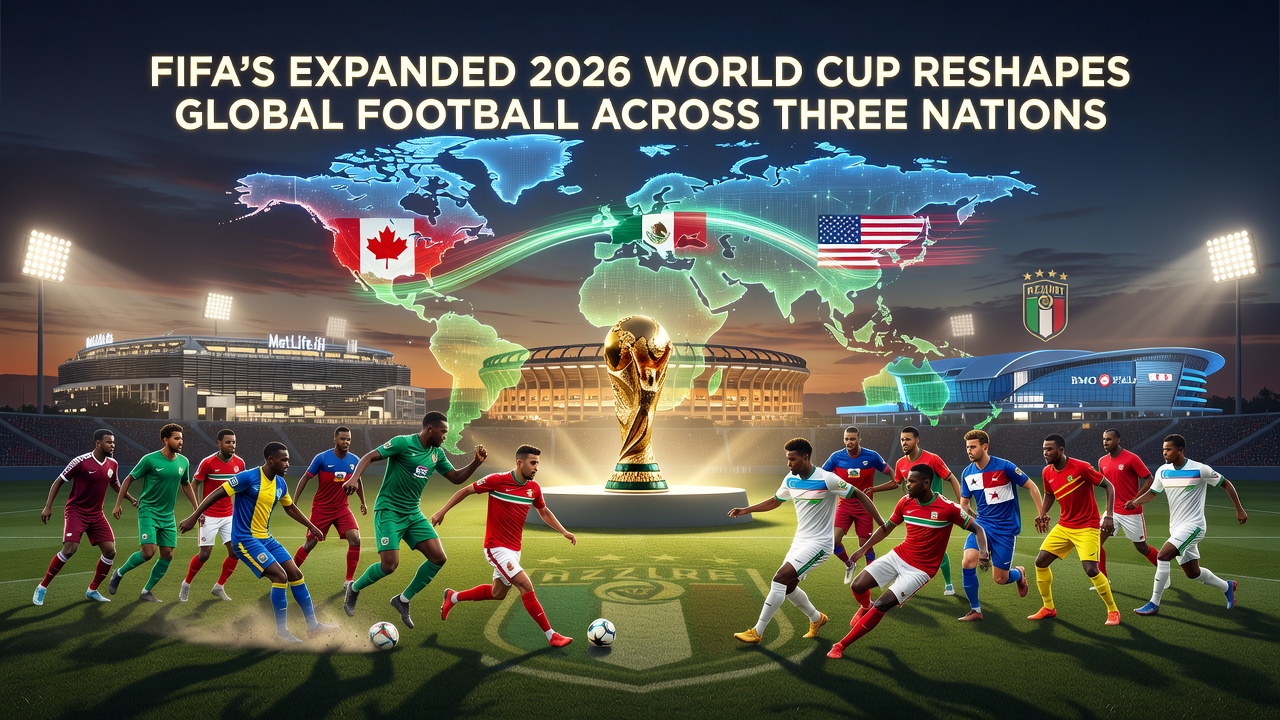
The 2026 FIFA World Cup will be unlike any that came before it. Spanning Canada, Mexico, and the United States across 39 days from June 11 to July 19, the 23rd edition of the tournament breaks new ground on virtually every front - largest ever field, first tri-nation host, and a knockout stage that doubles the number of advancing teams. With 48 sides competing across 104 matches, football's flagship event has entered a new era.
The decision to expand the tournament was made by FIFA back in 2017, when the governing body voted to increase the field from 32 to 48 teams starting with this edition. The structural shift is significant: teams are divided into 12 groups of four, with the top two from each group plus eight best third-placed sides - 32 teams in total - progressing to the round of 16. That is double the number that historically survived the group stage, giving more nations a genuine path to the knockout rounds. It is a change that has drawn both enthusiasm from emerging footballing nations and measured criticism from purists who value the ruthless compression of the old format. For fans following sports across multiple disciplines, the scale of the event puts it in a category of its own, though the same appetite for global competition is evident in sports ranging from basketball to, yes, even pariuri sportive handbal, where international tournaments have similarly grown in reach and following over the past decade.
Four nations will experience a World Cup for the first time when the tournament kicks off in June: Cabo Verde, Curaçao, Jordan, and Uzbekistan. Their qualification represents one of the clearest arguments in favour of expansion - smaller footballing nations that have steadily developed their programmes now have a credible route to the biggest stage in the sport. Cabo Verde's presence is particularly meaningful for African football, a continent where the depth of talent has long outpaced the number of available berths. Qatar, Haiti, Panama, and the Democratic Republic of the Congo each appear for just the second time, underlining how the enlarged format shifts the competitive landscape across confederations.
Italy's Absence Casts a Long Shadow
No storyline heading into 2026 carries more weight historically than Italy's failure to qualify - and it is, remarkably, the third consecutive World Cup the Azzurri have missed. The four-time world champions were absent in Russia in 2018 and again in Qatar in 2022, both exits coming via the European play-offs in circumstances that shook Italian football to its foundations. A third straight failure confirms that those were not isolated shocks but symptoms of a deeper structural malaise in the Italian game. Italy are the only former winner absent from the 2026 edition, a distinction that would have seemed unthinkable to previous generations. Every other nation to have lifted the trophy - Brazil, Germany, Argentina, France, England, Spain, Uruguay - will be present.
A Tournament Shaped for New Markets and New Audiences
Hosting across three countries is logistically complex, but it is also a deliberate strategic move by FIFA. The United States remains the world's largest untapped football market in terms of growth potential, and the 1994 World Cup on American soil demonstrably accelerated interest in the sport domestically. Canada, meanwhile, qualified automatically as co-host and will participate in just its second ever World Cup, having appeared in the 1986 edition in Mexico. The North American setting also places the competition in the same time zones as one of football's most passionate diaspora audiences - the Latin American communities spread across the continent whose connection to the game runs as deep as anywhere on earth.
What the Expanded Format Means in Practice
The 39-day duration - roughly a week longer than previous tournaments - reflects the additional matches generated by the expanded field. Fourteen more games than the 90 played at a 32-team World Cup means more fixtures, more scheduling complexity, and more demands on player welfare, a point that player unions and club managers have raised with increasing urgency in recent years given the crowded global football calendar. For neutrals and broadcasters, however, more matches means more football - more stories, more upsets, and more opportunities for the kind of iconic moments that define World Cups for generations. Whether the format ultimately enriches the product or dilutes it will only be answered once the tournament unfolds. What is certain is that on June 11, when the first whistle blows, football will have arrived at one of the most consequential editions in its history.