Gauff Reaches First Wimbledon Semifinal by Rewriting Her Own Grass-Court Rules
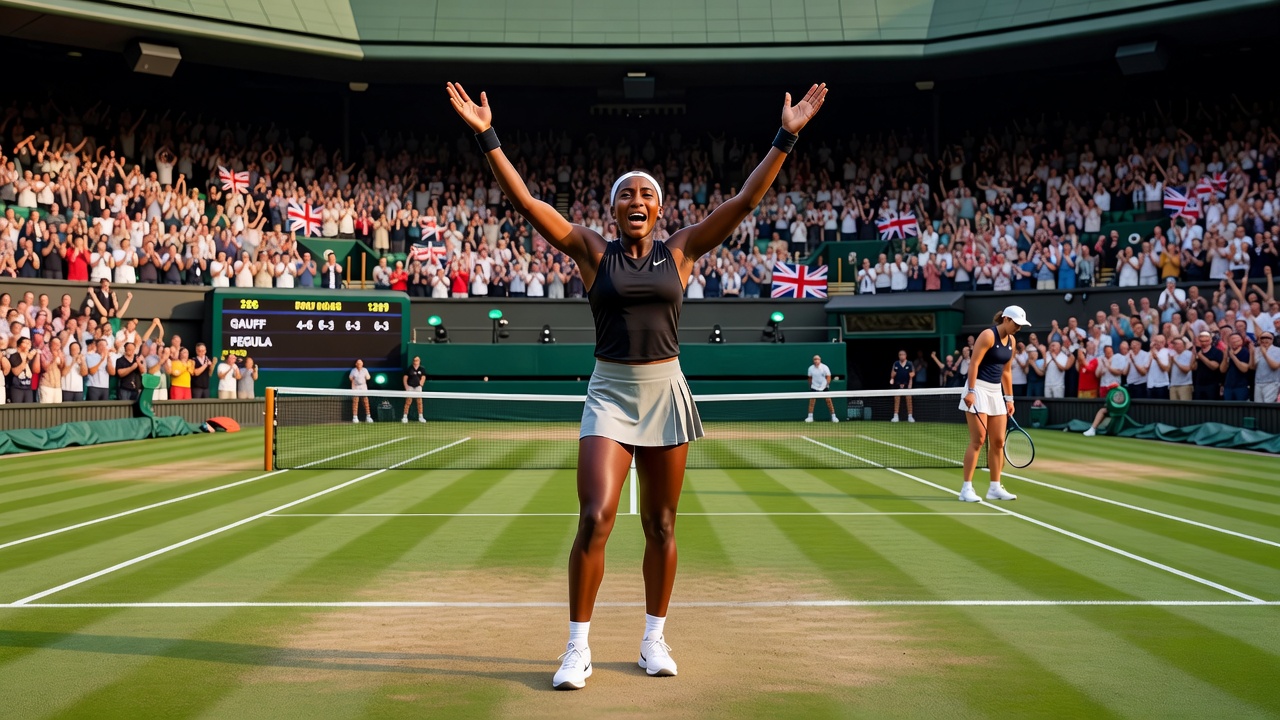
Coco Gauff is in the Wimbledon semifinals, and the manner of her arrival is as striking as the fact of it. The 22-year-old American defeated compatriot Jessica Pegula 4-6, 6-3, 6-3 on Centre Court Tuesday, advancing to the last four at the All England Club for the first time in her career - a result that, by her own admission, she would have laughed off as fantasy just a fortnight ago.
The context makes this all the more remarkable. Gauff arrived at Wimbledon without a grass-court victory in two years, having lost her opening match in Berlin ahead of the tournament. She briefly considered entering a last-minute tune-up event, a familiar resort for players chasing confidence, before deciding instead to stay in practice and rebuild from the ground up - a decision that, in hindsight, looks close to inspired. American sport is increasingly defined by athletes who trust process over panic, a theme that resonates far beyond tennis; much as the usa hosts a broader conversation about sport, identity and ambition, Gauff's quiet pre-tournament recalibration captures something of that same national sporting character - the willingness to tear things down and rebuild on your own terms.
Against Pegula, 32, a player with a well-established record on the faster surfaces of the European grass swing and widely considered the favourite coming into the match, Gauff did something tactically counterintuitive: she refused to play grass-court tennis. Instead of keeping points short and hunting the net on every opportunity, she dragged Pegula into long, looping baseline exchanges, using high, heavy forehands and flatter backhands to push her opponent behind the baseline, where balls would rise awkwardly out of the strike zone. It was clay-court thinking applied to a lawn, and it worked.
A Match Won From Behind the Baseline
There were concessions to the surface. Gauff served-and-volleyed five times - rare for her - and converted three of those points. Her first serve, once it found its range, was a genuine weapon, reaching 126mph at its peak and repeatedly wrong-footing Pegula. She also won all 12 extended points that ran to at least nine shots, a number that tells its own story about who controlled the physical and mental grind of the match.
The first set was scrappy and largely Pegula's. Gauff committed 15 unforced errors against just six winners, and double faults at critical moments - two in the game that gave Pegula the early break, two more as she surrendered a 3-3 parity - underscored the looseness that has often defined her grass-court struggles. But the second set saw a shift. As the afternoon heat built, Gauff's shoulder loosened, her serve sharpened, and she began winning the short points as decisively as she was winning the long ones. She won just 16 of 39 points lasting four shots or fewer in the first set; by the third, that figure had climbed to 24 from 38.
Pegula, to her credit, did not fold quietly. With Gauff leading 3-2 in the third set, she fought back to level, outlasting her opponent in the kind of scrambling, corner-to-corner baseline battle that Gauff typically uses to break others. But the momentum had been established, the pattern locked in. When Gauff broke again and eventually served out the match, her arms flew above her head in what looked like genuine disbelief.
Learning to Be Herself on a Different Surface
"If you told me I would be in the semis of this tournament, I'd be like, 'You're funny,'" Gauff said at her post-match news conference, laughing as she spoke. The self-awareness was not false modesty. She acknowledged that, evaluated purely on surface suitability, she would have picked Pegula to win. "I know tennis," she said. "If I wasn't myself, I would take maybe her to win with that game style she has on this surface."
What Gauff has discovered across these five consecutive grass-court wins - a run she described as "pretty insane" - is that she does not need to become a grass-court player to win at Wimbledon. She needs to be Coco Gauff on grass: relentless, physically imposing off the ground, difficult to outrun, and capable of finding solutions mid-match that most players could not locate with a week to prepare. Her groundstrokes, she now believes, are good enough to compete with anyone on this surface. Tuesday's evidence supported that view.
Pegula's own assessment of the serve was telling. "She can serve really well, and then obviously sometimes she can throw in some double faults," the American said. "I think that's what makes it so hard to play against - you're not really sure what's coming." That unpredictability, traditionally a liability, has functioned here as a weapon.
Muchová Awaits in the Semifinals
On Thursday, Gauff faces Karolína Muchová, a player whose game is built on imagination - deceptive angles, delicate drop shots, and the capacity to conjure winners from positions that appear hopeless. It is a different kind of problem from the one Pegula posed, and it will require a different solution. Gauff has shown, over five matches at this tournament, that she is capable of identifying and executing those solutions as the situation demands.
She came to Wimbledon hoping, privately, to win a match on grass and perhaps reach the quarterfinals. She has exceeded both targets with matches to spare. Whatever happens on Thursday, this fortnight has confirmed something that her two Grand Slam titles had already suggested: Gauff is not a specialist on any surface, but she is a contender on all of them. That is a rarer quality than it sounds, and at 22, she is only beginning to understand how to use it.