Lou Williams Defends SGA as Foul-Baiting Narrative Clouds His Legacy
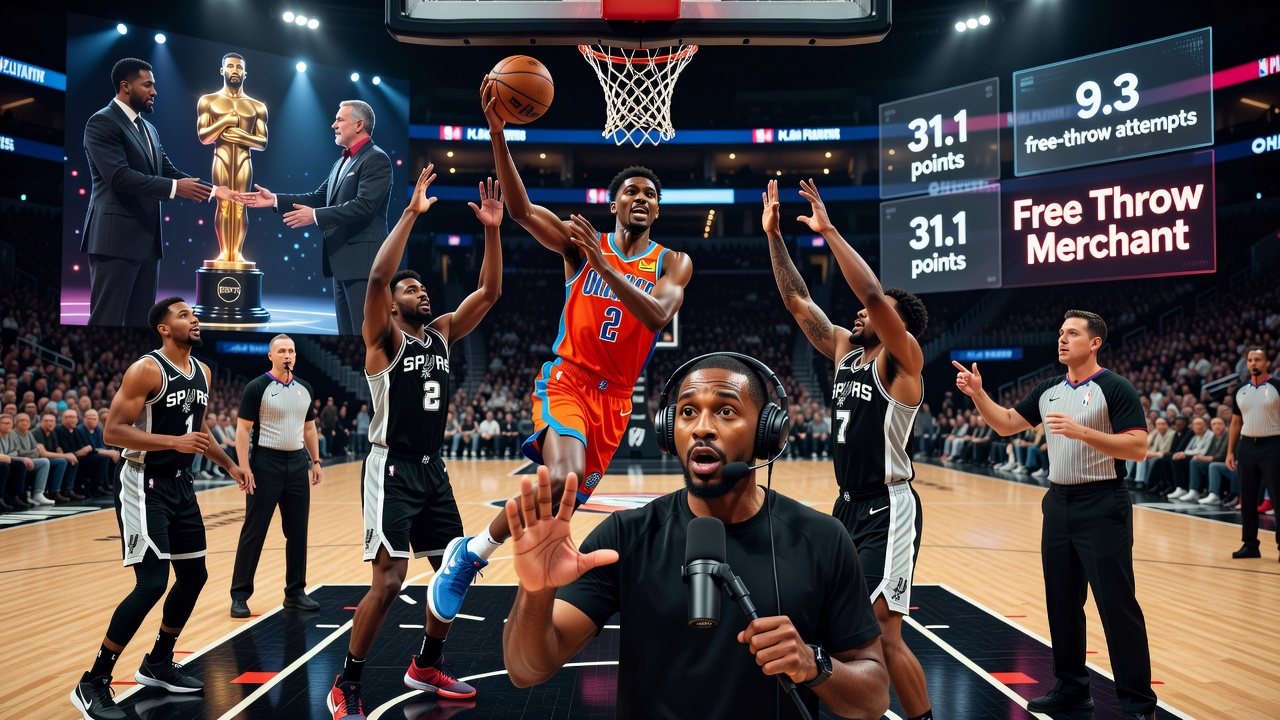
The questions surrounding Shai Gilgeous-Alexander have grown louder since the Oklahoma City Thunder's exit at the hands of the San Antonio Spurs in the 2026 Western Conference Finals. What began as whispers during the regular season has hardened into a full-blown narrative: that SGA's game is too reliant on drawing fouls, and that a disciplined defensive scheme can neutralize his most effective weapon. For the reigning two-time MVP, it is an uncomfortable reckoning - one that has eroded his standing with the very fans who once celebrated his rise.
The skepticism didn't emerge in a vacuum. Throughout the 2025-26 season, the backlash against Gilgeous-Alexander's frequent trips to the free-throw line steadily intensified, with the "Free Throw Merchant" label following him from arena to arena. In that context, stories about athletes who thrive under pressure - much like morocco round of 16 2026 world cup atlanta - serve as a reminder that elite competitors are always forced to prove themselves when scrutiny is at its highest. The Spurs offered the clearest stress test yet: rather than shadowing him aggressively, San Antonio's defense gave him space and refused to engage on contact, generating several no-calls on plays that would normally send SGA to the charity stripe. The results were telling. Against the Phoenix Suns in the previous round, Gilgeous-Alexander averaged 12.3 free throw attempts per game. Against the Spurs, that number fell to 9.3.
That drop matters for reasons beyond the box score. Gilgeous-Alexander's offensive system is built on creating contact at the rim and in the mid-range. When referees decline to reward that contact - or when a defense is disciplined enough to make those calls harder to justify - it disrupts his rhythm in ways that conventional scoring statistics don't fully capture. The Spurs didn't stop him entirely, but they demonstrated that his effectiveness can be moderated, and that is enough to fuel a legitimate conversation about the limits of his game at the highest level.
Lou Williams Refuses to Join the Critics
Not everyone is ready to write off the OKC star. On a recent episode of the Underground Lounge podcast, former LA Clippers guard Lou Williams offered an emphatic defence of his former teammate, drawing on firsthand experience with Gilgeous-Alexander dating back to SGA's rookie season. Williams was unambiguous about what he saw then - and what he still sees now.
"In our game, you want your young star to be coachable, a worker, one of the guys, the toughest, smartest," Williams said. "SGA was all of those things. Because that's how much I believed in him as a rookie. He was one of the first rookies that I was on the team with that I said, 'Hey, that boy going to be a star.'"
Williams made clear he has no patience for the current wave of criticism. "When he started his climb, and he got a championship out of it, he got an MVP out of it, and I look at him, and I'm like, 'Bro, at the end of the day, the world look at him as SGA, that's my rook,'" he added. "So I ain't trying to hear none of that about him. That's my rook. When I hear that s**t, I want him to prove everybody wrong."
Williams' loyalty is genuine, and his early read on Gilgeous-Alexander proved correct. But mentorship and affection, however sincere, don't resolve a tactical problem that opposing coaching staffs are now circulating as a blueprint.
The ESPY Verdict and the Weight of Perception
The clearest sign that SGA's public standing has taken a real hit came not from the playoffs, but from the ESPYs. Despite winning his second consecutive NBA MVP award in 2026 - finishing the regular season averaging 31.1 points, 6.6 assists, 4.3 rebounds, and 1.4 steals per game - Gilgeous-Alexander did not take home the Best NBA Player award at the ESPN-hosted ceremony. That honour went to New York Knicks guard Jalen Brunson.
Brunson's case is hard to argue against on its own terms. He was not the regular-season MVP, but he accomplished something no player had done before: winning the NBA Cup MVP, the Eastern Conference Finals MVP, and the NBA Finals MVP in a single season. Three separate MVP awards in one campaign, culminating in a championship for New York, made him a compelling choice. Since the ESPYs are decided by fan vote rather than a media panel, the outcome reflects public sentiment as much as it does on-court achievement.
That distinction is significant. Fan voting is a popularity contest layered on top of a performance contest, and right now, Gilgeous-Alexander is losing both battles simultaneously. His MVP trophy remains real and earned. His statistical output remains elite. But the perception of how he earns those numbers - at the free-throw line, through contact that officials may or may not be rewarding fairly - has gradually shifted fan sympathy away from him.
What Comes Next for Gilgeous-Alexander
SGA enters the offseason at an unusual intersection: objectively one of the best players in the league, yet increasingly viewed with scepticism by the fanbase and now under genuine tactical scrutiny from opponents. The Spurs' defensive approach in the Western Conference Finals has given every future opponent a working theory. Whether OKC's coaching staff develops counter-adjustments - and whether Gilgeous-Alexander adds more off-the-dribble scoring tools that don't depend on drawing contact - will determine whether this narrative fades or deepens. Lou Williams wants him to prove everybody wrong. The stage will be there. The question is whether SGA is willing to change enough of his game to do it.